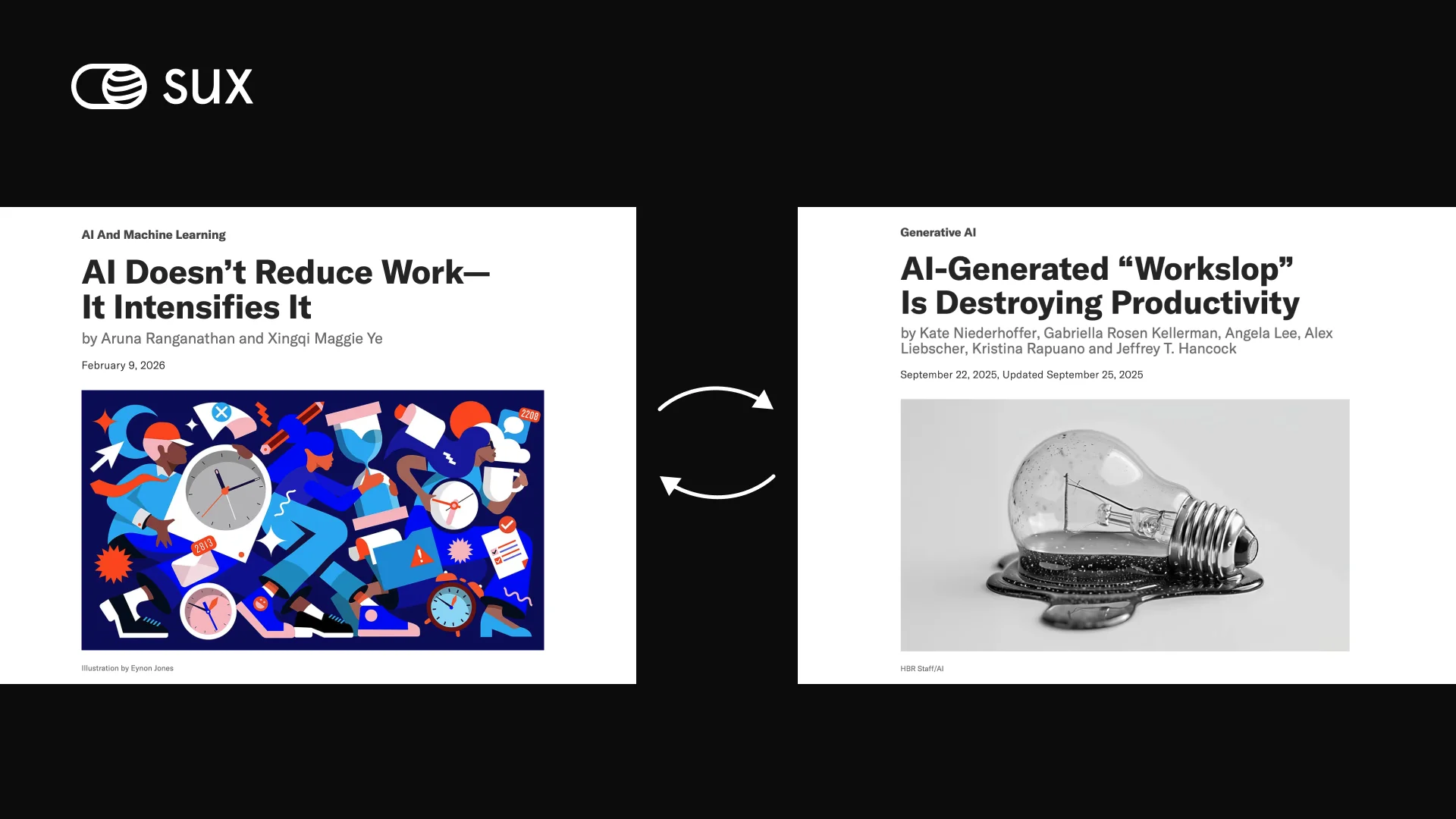
According to a recently published study, “AI tools don’t reduce work, they consistently intensify it: In the study, employees worked at a faster pace, took on a broader scope of tasks, and extended work into more hours of the day, often without being asked to do so. That may sound like a win, but it’s not quite so simple. These changes can be unsustainable, leading to workload creep, cognitive fatigue, burnout, and weakened decision-making. The productivity surge enjoyed at the beginning can give way to lower quality work, turnover, and other problems.”
And now let’s put that into relation of a another study from last year. That study focussed on the real value created with AI: “As AI tools become more accessible, workers are increasingly able to quickly produce polished output: well-formatted slides, long, structured reports, seemingly articulate summaries of academic papers by non-experts, and usable code. But while some employees are using this ability to polish good work, others use it to create content that is actually unhelpful, incomplete, or missing crucial context about the project at hand. The insidious effect of workslop is that it shifts the burden of the work downstream, requiring the receiver to interpret, correct, or redo the work. In other words, it transfers the effort from creator to receiver.”
So, summarized, research shows
- that AI is often used to do things faster, but with less quality, which enhanced productivity (time-wise) of the creator, but results often in extra work for the person who needs to work with the results of the initial creator: Productivity increase of Person A is often paid with productivity decrease of Person B.
- that even the people fulfilling tasks faster with AI do not really profit from it. Instead the time won is used to do more things and more things in parallel, which will result in less good results and worse, in mental health issues.
The productivity narrative of AI is a nice fairy-tale. The truth is: AI can help to increase productivity in specific use cases if used the right way, with care and with enough time for review and for the right use-cases. But the reality is, AI at the moment very often is used for short-term pseudo success, where problems pop-up later. And the reality is that it is very often used to push the good old mantra of capitalism: infinite growth is above everything and values more than societal balance and mental health.
We should keep that in mind before we jump on the AI-productivity hype-train.
--
If you want to learn more about Ethics and Sustainability in the context of AI and about its true price, have a look at our Masterclass "Sustainability and Ethics in AI":
We offer this as an open format as well as for teams and organizations. Find all Infos on the page or get in touch with me.
--
Ressources:
AI Doesn’t Reduce Work—It Intensifies It by Aruna Ranganathan and Xingqi Maggie Ye:
https://hbr.org/2026/02/ai-doesnt-reduce-work-it-intensifies-it
AI-Generated “Workslop” Is Destroying Productivity by Kate Niederhoffer, Gabriella Rosen Kellerman, Angela Lee, Alex Liebscher, Kristina Rapuano and Jeffrey T. Hancock
https://hbr.org/2025/09/ai-generated-workslop-is-destroying-productivity
Thorsten Jonas is the Founder of the SUX Network and Digital Sustainability, Sustainable UX and Responsible AI expert, keynote speaker and author. He is guiding teams and companies in crafting sustainable, responsible and ethical digital products, advocating for a sustainable digital world and works as invited expert for the W3C Web Sustainability Guidelines.